Nijmegen is one of the oldest cities in the Netherlands and one of the most sports-oriented. Its compact layout, strong infrastructure, and deep connection to athletic culture made it the natural choice to host EuroGames 2022 – and the event left a lasting mark on the city’s sporting identity.
A City with Deep Historical Roots
Nijmegen’s recorded history stretches back over two thousand years. Founded as a Roman settlement on the south bank of the Waal, the city grew through the medieval period to become one of the most significant urban centres in the Low Countries. Its position on the river gave it strategic importance, and its university, founded in 1923, has since made it one of the largest student cities in the Netherlands.
That student population – numbering around 40,000 in a city of 180,000 – is relevant to Nijmegen’s sporting identity. Universities generate sport. They create demand for facilities, coach development pathways, and vibrant club scenes that outlast the students who initially build them. Nijmegen’s sports infrastructure reflects decades of investment driven partly by this dynamic.
The Nijmeegse Vierdaagse
If there is one event that defines Nijmegen’s relationship with sport, it is the Nijmeegse Vierdaagse – the International Four Days Marches. First held in 1909, this is one of the world’s largest multi-day walking events, drawing up to 47,000 participants annually from over 70 countries. The routes cover 30, 40, or 50 kilometres per day over four consecutive days, passing through the Gelderse Vallei and the rolling heathland of the Veluwe.
The Vierdaagse is not merely a sporting event – it is a cultural institution. The week of the marches transforms Nijmegen: the city fills with participants and supporters, hotels book out months in advance, and the atmosphere reaches a sustained pitch of collective celebration that few other events can match. For Nijmegen, sport is not an add-on to civic life – it is woven into the fabric of the city.
The official Nijmegen tourism guide to the Vierdaagse provides detailed information about the event and its significance for the city.
The River Waal and Water Sports
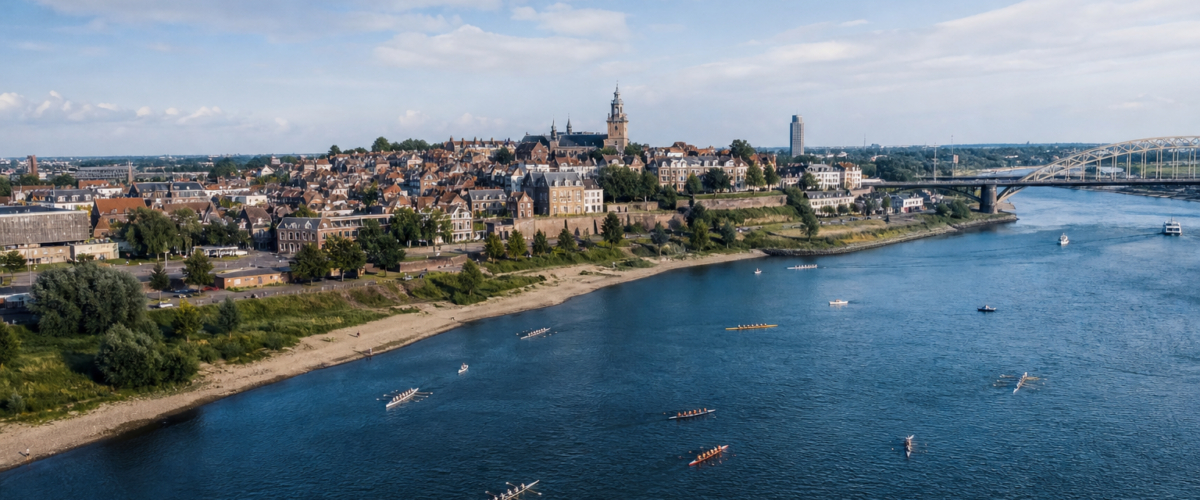
The Waal is the dominant physical feature of Nijmegen’s landscape, and water sports have been part of the city’s athletic culture for as long as rowing clubs have existed in the Netherlands. The river’s straight, wide stretches downstream of the historic centre provide ideal flatwater rowing conditions during low-water periods, and several clubs maintain boathouses along the Nijmegen riverbank.
EuroGames 2022 made full use of this infrastructure for its rowing programme. Competitors from across Europe contested sprint and time-trial events on the Waal, with the old city rising dramatically on the hill above the south bank as a backdrop. It was one of the most visually distinctive venues of the entire event.
Beyond rowing, the river and surrounding water bodies accommodated open-water swimming and triathlon events. The combination of river and lake venues within easy cycling distance of the city centre gave EuroGames 2022’s aquatic programme a range and quality that few events in similarly-sized cities could match.
Cycling and the Surrounding Landscape
Nijmegen sits on the edge of two very different landscapes. To the north and east, the river floodplains give way to the forests and heathland of the Veluwe – the largest nature reserve in the Netherlands and one of the best cycling areas in the country. To the south, the land opens onto the agricultural plains of the Betuwe, criss-crossed by dykes and fruit orchards.
Both landscapes featured in EuroGames 2022’s cycling programme. Road races took competitors through the Veluwe’s pine forests and across the open polder farmland of the Gelderse Vallei, creating courses that combined scenic variety with genuine athletic challenge. The region is already well-established as a cycling destination – several professional spring classics pass through the area – and the EuroGames added to its reputation as a place where cycling is taken seriously.
Indoor Sports Venues
For team and indoor sports, Nijmegen relied on a network of existing facilities supplemented by temporary installations. The GelreDome – primarily a football ground and concert venue on the city’s northern outskirts – served as an anchor venue for several disciplines. Sports halls across the city hosted volleyball, basketball, badminton, and martial arts, while dance sport and gymnastics found space in the large-format indoor venues typical of Dutch university cities.
The dispersal of venues across Nijmegen and the surrounding municipality meant that the event had a genuinely distributed footprint. Rather than clustering everything around a single Olympic park, EuroGames 2022 spread its footprint across the city’s existing sporting geography, creating an event that felt embedded in the city rather than imposed upon it.
Legacy for the City
Hosting a major multi-sport event leaves traces that outlast the competition itself. In Nijmegen’s case, the most tangible legacies were infrastructure improvements at several venues, a boost to the membership of local sports clubs that had hosted competition, and a heightened profile for the city as a destination for sporting tourism.
Less tangible but arguably more important was the cultural legacy: EuroGames 2022 demonstrated that Nijmegen could host a large, diverse international event efficiently and with genuine warmth. That reputation matters when future event bids are being considered – and it matters to the city’s own residents, who saw their home at its most welcoming and internationally engaged.
Discover the range of sports disciplines that took place during EuroGames 2022, or learn more about the editorial team behind this site on our about page.