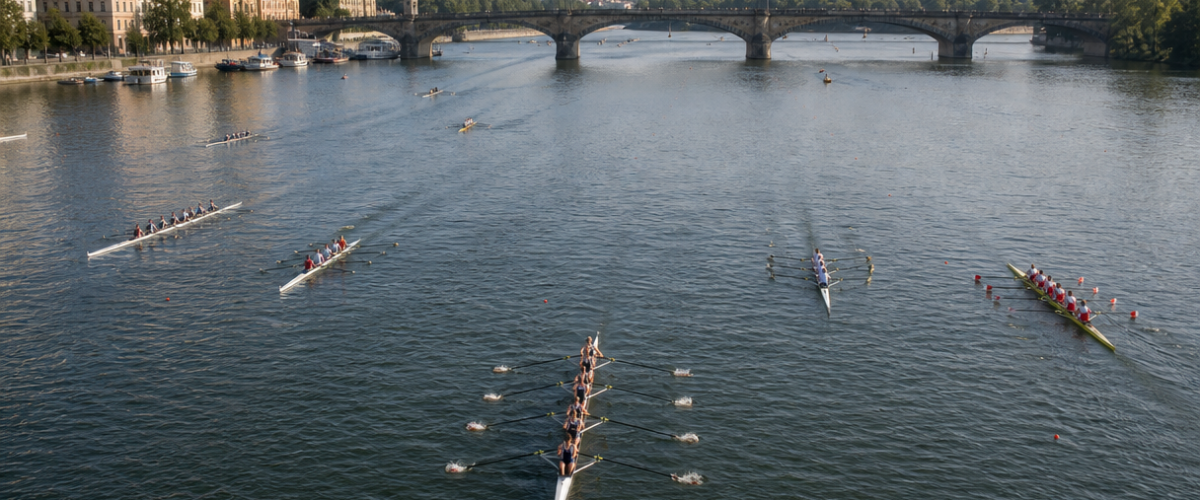
Rowing is one of the oldest competitive sports in Europe, with organised racing records stretching back to the eighteenth century. At multi-sport events like EuroGames 2022, it occupies a distinctive place: demanding enough to challenge serious athletes, yet accessible enough to welcome club-level competitors from across the continent.
The Discipline of Rowing
At its core, competitive rowing involves propelling a narrow boat through water using oars, with athletes seated and driving the blade through the water in a coordinated sequence. The sport divides into two fundamental categories: sculling, in which each rower holds two oars; and sweep rowing, in which each rower holds one oar, typically in crews of two, four, or eight.
Flatwater rowing – the form most commonly seen at multi-sport events – takes place on calm bodies of water such as lakes, reservoirs, and wide rivers. Racing distances vary from 250 metres (sprint events) through 500 metres and 1,000 metres to the classic 2,000-metre Olympic distance. EuroGames events typically include a range of distances to accommodate different ability levels and age groups.
Rowing’s demands are total-body: it engages the legs, core, back, and arms in a sequence that must be repeated hundreds of times per race. A strong 2,000-metre rower combines raw power output with exceptional aerobic capacity and the technical skill to apply force efficiently at high stroke rates. Developing that combination takes years of dedicated training.
Rowing at EuroGames 2022
Nijmegen provided an exceptional rowing venue for EuroGames 2022. The River Waal runs wide and straight along the southern edge of the old city, offering stretches suitable for flatwater sprint racing during the summer low-water period. The course was set up on the Waal downstream of the historic bridge, with the distinctive silhouette of the Valkhofpark rising above the south bank.
Competitors raced across multiple boat classes and age categories, with events including single sculls, double sculls, coxed fours, and eights. The multi-category format ensured that both elite club rowers and recreational participants could find competitive environments appropriate to their level. Masters categories – which in rowing cover age groups from 27 upward – were particularly well-subscribed, reflecting the sport’s long tradition of participation well beyond youth.
The logistics of staging rowing competition on a working river required careful coordination with river traffic authorities and local port management. Race windows were scheduled around commercial barge movements, and safety boat crews maintained continuous watch over the racing lanes. The coordination worked smoothly, and weather conditions during the racing days were close to ideal.
Inclusivity in Rowing
Rowing has historically been associated with elite institutions and high entry barriers – expensive equipment, restricted access to water, and coaching available mainly to those in well-resourced clubs. In recent decades, the sport has made deliberate efforts to broaden its base, with development programmes targeting schools, community clubs, and under-represented groups.
EuroGames-style events accelerate this broadening process. By bringing LGBTQ+ rowing clubs from across Europe into competition together, they create a network of shared experience and mutual support that persists between events. A club that sends three boats to EuroGames returns with contacts, training ideas, and a renewed sense of purpose – benefits that compound over years and help sustain clubs through the quieter periods between major competitions.
Adaptive rowing – competition for athletes with physical disabilities – has also grown significantly within the EuroGames format. The integration of adaptive categories into the mainstream programme, rather than segregating them into a separate event, sends a clear message about the sport’s values and makes for a richer competitive environment for all participants.
Training for Multi-Sport Rowing Events
Preparation for a multi-sport rowing event differs from preparation for a single-discipline championship. Competing athletes must balance rowing-specific training with the practical demands of a multi-day event – travel, acclimatisation, multiple heats, and the social energy of a large gathering. For many participants, the challenge is not the rowing itself but managing the fatigue that accumulates across several days of competition.
Most coaches recommend that athletes preparing for multi-sport events prioritise consistency over peak fitness. A rower who has maintained steady training through the preceding six months will typically outperform one who has trained intensively for eight weeks before the event. Endurance base, technical consistency, and the ability to row well when tired are more valuable at this level than absolute speed.
World Rowing and the International Context
Rowing’s international governance is provided by World Rowing, which organises the World Rowing Championships, World Cups, and a growing programme of development events. The sport’s Olympic and Paralympic programmes continue to evolve, with adaptive rowing categories expanding the number of athletes who can participate at the highest level.
At the club and community level, European rowing is organised through national federations affiliated to World Rowing. These federations run domestic competition calendars that provide the competitive bedrock from which multi-sport event participants emerge. The World Rowing Championships showcase the highest level of the sport and provide context for understanding what club-level multi-sport competition looks like by comparison.
For more on the full range of disciplines at European multi-sport events, or to understand how Nijmegen’s riverside setting shaped the EuroGames 2022 rowing programme, explore the related sections of this site.